
Have you been following what is happening in the testing world in recent times? Then you already know things are changing fast. And not in a small, gradual way. It feels more like the ground shifting under your feet.
Automation used to mean one thing: write a script, run it, check the results. That was the job. Now, the conversation has moved in a completely different direction. People talk about AI systems that not only follow instructions but also think through what needs to get tested. That is what Agentic AI testing is about.
In 2026, companies are not only hiring testers who can write automation scripts but also know how to work with intelligent systems that can generate tests on their own, determine why something failed, and adjust their behavior based on the application’s response.
And honestly? That is a lot to take in. For most QA engineers, this shift feels exciting on one hand and a little unsettling on the other. You have spent years building solid skills, and now the landscape is changing again. That feeling is completely valid. But here is the thing: this is not about replacing what you know. It is about building on top of it.
So, get into what Agentic AI testing actually is, and more importantly, what you can do right now to ensure you are ready for it. You may also go for all-access subscriptions from a trusted platform for detailed guidance in this journey.
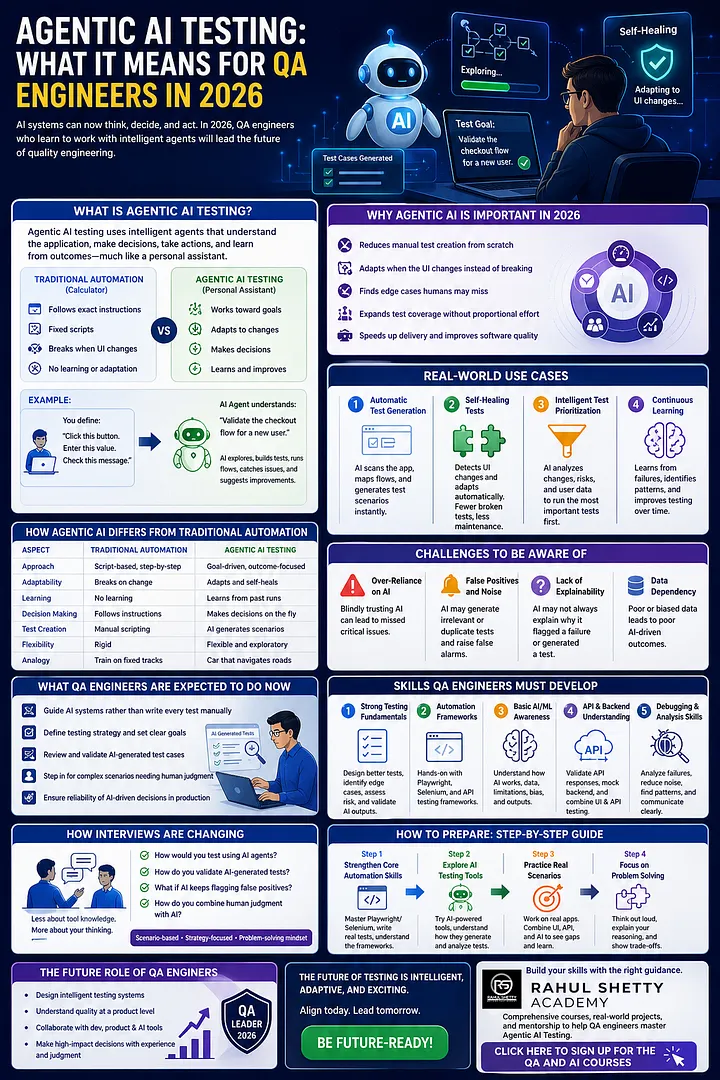
What Is Agentic AI Testing? A Comprehensive Overview
Start with the basics because you will hear this term numerous times. But unfortunately, this is not always explained well.
Agentic AI testing means using AI systems that behave more like independent agents than simple tools. Think of the difference between a calculator and a personal assistant. A calculator does exactly what you tell it. A personal assistant can take a goal, figure out the steps, and get things done without you spelling out every detail.
Traditional automation tools work like calculators. But agentic systems work more like that assistant. They can:
● Understand what the application is doing and why
● Make decisions about what to test next
● Take actions without being explicitly told each step
● Learn from what happened last time and adjust
So instead of you sitting down and writing something like:
“Click this button. Enter this value. Check this message.”
You can now define a higher-level goal like:
“Validate the checkout flow for a new user.”
And the AI agent takes it from there. It will explore the interface, figure out what elements are on the screen, build out the test steps, run through the flows, catch what breaks, and even suggest what could be improved. That is a completely different way of thinking about automation. And once you see it in action, it is hard to go back to thinking about testing the old way. While studying this new approach, make sure you follow the correct learning paths that will not only take you to the basic points but also help you delve deeper.
Why Agentic AI Is Becoming So Important in 2026
Here is the thing about modern software. It is complicated. Really complicated.
The apps being built today are not the simple three-tier web applications from ten years ago. They have:
● Frontends that change dynamically based on user behavior
● Dozens of microservices talking to each other behind the scenes
● Real-time data flowing in from multiple sources
● Deployments happening multiple times a day
Trying to keep manual test scripts up to date with all of this is genuinely exhausting. Anyone who has worked in a fast-moving team knows the feeling. You spend half your time fixing broken tests instead of actually finding bugs.
Agentic AI addresses this directly. It helps by:
● Reducing how much manual test creation you have to do from scratch
● Adapting when the UI changes instead of just breaking
● Finding edge cases that no one thought to write a test for
● Expanding overall test coverage without proportional effort
This is why companies are investing here. It is not just a technology trend. It makes practical, business sense because it speeds things up, cuts down on maintenance, and actually improves the quality of what gets tested. Here, you need the right mentorship that will broaden the path forward so you can master this skill and confidently implement it in real-life scenarios.
How Agentic AI Differs from Traditional Automation: Here’s Your Answer
This is something you really want to get clear on before any interview, because it will come up.
● Traditional Automation: It is built around predefined scripts. You tell it exactly what to do, step by step. When something on the page changes, even something small like a button label or an element ID, the script breaks. Someone has to go in and fix it. There is no flexibility built in.
● Agentic AI Testing: It works differently at its core. Instead of following a rigid script, it works toward goals. This AI testing method can detect when something has changed and figure out how to handle it. It learns from previous runs. It does not need you to anticipate every possible scenario because it can explore and generate scenarios on its own.
If traditional automation is like a train running on fixed tracks, Agentic AI is more like a car. It can navigate around obstacles, take a different route, and still get to the destination. Understanding this difference is not just useful for interviews. It changes how you think about designing your entire testing approach.
What QA Engineers Are Expected to Do Now in This Scenario
Let’s confess something vital: Agentic AI is not going to take your job. But it is going to change what your job looks like, sometimes quite significantly. In 2026, QA engineers are increasingly expected to:
● Guide AI systems rather than write out every single test manually
● Define the testing strategy and set clear goals for what needs to be validated
● Review and validate what the AI generates, because it is not always right
● Step in for complex scenarios where human judgment and experience matter
● Take responsibility for the reliability of AI-driven decisions in production
What this really means is that the repetitive, formulaic parts of your job start to shrink and the thinking, analytical, strategic parts grow. For a lot of engineers, that is actually a better deal. You spend less time grinding through scripts and more time solving real problems.
Skills QA Engineers Must Develop to Shine in This Field
What do you actually need to know? To stay relevant, QA engineers must build a broader and deeper skill set. These include:
1. Strong Testing Fundamentals
This might sound old-fashioned, but fundamentals are genuinely more important now. When AI generates a bunch of test cases, you need to be the one who looks at them and says, “This one makes sense. This one is missing something. This one is testing the wrong thing entirely.”
That judgment comes from understanding:
● How to design tests that actually catch real problems
● What boundary conditions and edge cases look like in practice
● When a negative scenario matters and when it does not
● How to approach testing based on risk, not just coverage numbers
AI can produce tests at scale. You need to know whether those tests are worth anything.
2. Understanding of Automation Frameworks
Agentic AI does not replace frameworks like Playwright or Selenium. It works on top of them or alongside them. If you do not understand how these frameworks operate at a basic level, you will struggle to guide AI tools effectively. You will also find it hard to debug when something goes wrong, which it will. Get comfortable with:
● How Playwright handles locators, waits, and assertions
● How Selenium WebDriver manages browser interactions
● How API testing frameworks structure requests and validate responses
This foundation makes everything else easier.
3. Basic AI and ML Awareness
You do not need to become an AI researcher. Nobody is expecting you to fine-tune language models or write machine learning pipelines. But you should understand enough to:
● Know roughly how AI models arrive at their outputs
● Understand what training data is and why its quality matters
● Recognize where bias or limitations might show up in AI-generated results
This kind of awareness helps you interpret what AI testing tools are actually telling you, rather than just accepting the output at face value.
4. API and Backend Understanding
This one is non-negotiable in 2026. Almost every modern application is API driven, and Agentic AI testing often involves working at the API layer as much as the UI layer.
You need to be comfortable with:
● Validating API responses and understanding what they mean
● Simulating backend behavior for testing purposes
● Combining UI level and API level testing in the same workflow
Engineers who only test through the browser are leaving a huge part of the application untouched.
5. Debugging and Analysis Skills
AI systems are good at generating results. They are not always good at explaining them in a way that makes sense to a human. You need to be the one who can:
● Look at a failure and figure out what actually caused it
● Separate real bugs from false alarms
● Identify patterns across multiple failures instead of treating each one in isolation
Debugging is one of those skills that just gets more valuable over time. It does not matter how smart the AI is. Someone still has to understand what the results actually mean.
Real World Use Cases of Agentic AI Testing
Theory is fine, but look at what this actually looks like in practice.
1. Automatic Test Generation
This is probably the most immediately visible use case. Instead of a QA engineer sitting down to write test cases one by one, an AI agent scans the application, maps out the key user flows, and generates a full set of test scenarios. It is not perfect. It does not know your business logic the way you do. But it handles the heavy lifting and gives you a starting point that would have taken days to produce manually.
2. Self-Healing Tests
Every QA engineer has felt the frustration of opening their CI pipeline in the morning to find twenty failing tests, not because anything is actually broken, but because someone changed a button label or an element ID. Agentic AI systems can detect those changes and adapt automatically. They figure out that the element has moved or changed, update their approach, and keep running. You spend your morning looking at real failures instead of fixing broken locators.
3. Intelligent Test Prioritization
Not all tests are equally important. Running your full test suite every time is slow and often unnecessary. AI can look at what changed in the last commit, what has failed recently, and how users actually behave in production, and use all of that to decide which tests matter most right now. This means faster feedback and less wasted time.
4. Continuous Learning from Failures
One of the more interesting capabilities is that Agentic systems can get smarter over time. They can track patterns in how and when tests fail, recognize recurring issues, and adjust their approach based on how the application evolves. Testing does not just stay static. It improves as the system runs more.
Challenges Modern QA Engineers Must Be Aware Of
This would not be a complete picture without talking about the limitations. Agentic AI is powerful, but it is not magic.
1. Over-Reliance on AI
This is probably the biggest risk. When a system can generate and run tests automatically, it is tempting to step back and just trust the results. That is a mistake. AI-generated tests miss things. They miss context. They miss business requirements. They miss what a real user would actually care about. Your judgment is not optional. It is essential.
2. False Positives and Noise
AI can generate a lot of tests very quickly. Not all of them are useful. Some are duplicates. Some test things that do not matter. Some raise alarms about things that are technically failures but practically irrelevant. Without someone to filter and evaluate, you end up buried in noise.
3. Lack of Explainability
This is a real limitation that does not get talked about enough. Sometimes an AI system will flag something as a failure or generate a test case, and you genuinely cannot tell why. That lack of transparency can make it hard to trust the results or communicate findings to the rest of the team.
4. Data Dependency
AI systems are only as good as the data they learn from. If your test data is messy, incomplete, or biased toward certain scenarios, your AI-driven results will reflect that. Garbage in, garbage out. That has always been true, and it is still true here.
How Interviews Are Changing Because of Agentic AI
Interview formats are shifting, and if you are not aware of this, you might walk into a conversation expecting one kind of question and get something completely different. Interviewers are moving away from purely tool-focused questions like “What Selenium commands do you know?” toward questions that test your thinking:
● How would you approach testing an application using AI agents?
● How do you validate whether AI-generated test cases are actually useful?
● What would you do if an AI system kept flagging false positives?
● How would you design a testing strategy that combines human judgment with AI assistance?
These questions are not really about what you have memorized. They are about how you think. They want to see that you understand the landscape, not just the syntax. Scenario-based questions are becoming much more common. The answer is less important than your reasoning process.
How to Prepare for Agentic AI Testing Roles: A Step-by-step Guide
Knowing what to prepare is one thing. Actually preparing is another.
Step 1: Strengthen Core Automation Skills
Before anything else, make sure your automation foundation is solid. AI tools build on top of frameworks, not instead of them. If your Playwright or Selenium skills are shaky, fixing that comes first. Get comfortable writing real automation code, not just clicking through record and playback tools. Understand what is happening under the hood.
Step 2: Explore AI Testing Tools
Start experimenting. You do not need to become an expert overnight, but you should have hands-on familiarity with tools that use AI to assist in testing. Understand how they generate test cases, how they analyze application behavior, and how they present results. The goal is to have an informed opinion, not just awareness that these tools exist.
Step 3: Practice Real Scenarios
The best preparation is working on something real. Take an actual application and try combining UI automation, API testing, and AI-assisted test generation. See where the gaps are. See what the AI misses. See what you have to add manually. That experience is worth more than any amount of theoretical study.
Step 4: Focus on Problem Solving
Stop preparing lists of questions and answers. That approach has a ceiling. Instead, practice talking through problems out loud. Explain your reasoning. Describe trade-offs. Show that you can think, not just recall. That is what separates strong candidates in 2026 interviews.
The Future Role of QA Engineers
Here is a perspective shift that might help. QA engineers are not becoming less relevant. They are becoming more strategic. The engineers who thrive in this environment will be the ones who:
● Design intelligent testing systems rather than just maintaining scripts
● Understand quality at a product level, not just a code level
● Work closely with developers, product managers, and AI tools as a genuine collaborator
● Make decisions that require experience and judgment that no AI has yet
That is a more interesting role than what most testers had five years ago. It is also a more impactful one.
For those who want a structured way to build these skills, turn to Rahul Shetty Academy for comprehensive support for QA engineers navigating this transition. The future of testing is intelligent, adaptive, and genuinely more interesting than what came before. The sooner you align with where things are going, the better positioned you will be when the opportunities come. So click here to sign up for the QA and AI courses.