Not long ago, a QA engineer’s job was limited to executing test cases, logging bugs, and signing off on releases. That world is gone. In 2026, software ships in hours. A single application touches dozens of microservices, cloud services, third-party APIs, and now AI models.
The testers who thrive are not the ones who click through screens manually. They are the engineers who build intelligent automation systems, evaluate AI behavior, and embed quality into every stage of delivery. This roadmap is your structured path from where you are today to where the industry is heading. Whether you are a complete beginner or an experienced manual tester looking to transition, every stage is laid out clearly. Also, you will know about the AI skills that are now separating average candidates from the ones getting hired.
So, are you ready?
The Solid Foundation Every QA Engineer Must Have to Propel Their Journey Successfully
What Is Software Testing, Really?
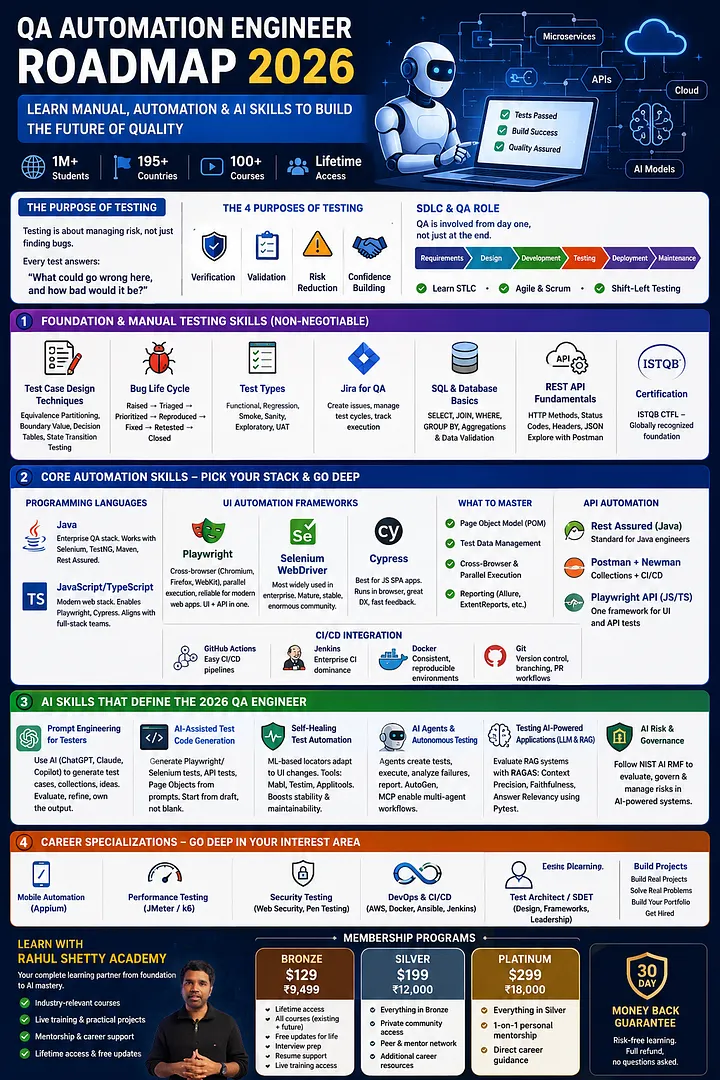
Before you touch a single automation tool, you need to understand the purpose of testing. Testing is not about finding bugs. It is about managing risk. Every test you write answers one question: “What could go wrong here, and how bad would it be?” This mindset shift, from bug hunter to risk manager, is what separates junior testers from senior engineers.
A junior tester asks: “Did this feature pass or fail?” A senior engineer asks: “What is the cost to the business if this breaks in production, and how much confidence do we need before we ship it?” Those are fundamentally different questions, and they lead to fundamentally different test strategies.
Software testing, at its core, serves four purposes that every QA professional should be able to articulate clearly:
● Verification
● Validation
● Risk Reduction
● Confidence Building
Understanding these four purposes changes how you approach every testing assignment. You stop asking “how many test cases did I write?” and start asking “have I covered the risks that actually matter here?”
The Software Development Life Cycle (SDLC) and Where QA Fits
You must understand how software is built before you can test it effectively. Study each phase of the SDLC, including requirements, design, development, testing, deployment, and maintenance. And learn exactly where QA contributes in each one. In modern Agile teams, QA is involved from day one, not just at the end.
Key concepts to master here:
● The Software Testing Life Cycle (STLC)
● Agile and Scrum Fundamentals
● Shift-Left Testing
Core Manual Testing Skills You Cannot Skip as a Potential QA Engineer
Automation cannot replace what you do not understand manually first. These are the skills every QA engineer must own before writing a single line of automation code.
● Test Case Design Techniques: Equivalence partitioning, boundary value analysis, decision tables, and state transition testing are the techniques that help you write test cases. These actually catch bugs rather than just confirming the happy path.
● The Bug Life Cycle: When a defect is found, it gets raised, triaged, prioritized, reproduced, fixed, retested, and closed. Knowing this cycle well and understanding how to write a bug report that a developer can act on immediately makes you far easier to work with.
● Test Types: Functional, regression, smoke, sanity, exploratory, and user acceptance testing all serve different purposes, and knowing when to use each one is something you pick up quickly with practice.
● Jira for QA: It is the bug tracking and project management tool that most engineering teams run on, so get comfortable creating issues, managing test cycles, and tracking your test execution inside it.
SQL and Database Basics for Testers
A huge proportion of application bugs live in the data layer, not the UI. Learning SQL well enough to query a database, validate records, check data integrity, and trace what happened behind the scenes after a test action is one of the highest-leverage skills a QA engineer can develop. Focus on SELECT queries, JOINs, WHERE clauses, GROUP BY, and basic aggregate functions. You do not need to be a database administrator. Rather, you need to be able to verify that what happened in the front end is accurately reflected in the back end.
REST API Fundamentals
Modern applications communicate through APIs far more than through user interfaces. Understanding REST API basics, like HTTP methods (GET, POST, PUT, DELETE), status codes, request/response structure, headers, and JSON, is essential groundwork before you get to API automation. Start exploring APIs with Postman. It has a visual interface that makes it easy to send requests, inspect responses, and understand how APIs behave before you automate them.
Certification: ISTQB CTFL
For formal validation of your foundation, the ISTQB Certified Tester Foundation Level is the globally recognized entry-level credential. It is widely listed in QA job postings and signals that your testing knowledge is grounded in industry-standard methodology.
Core Automation Skills: Pick Your Stack and Go Deep
Automation is programming. There is no way around it. The single most common mistake new automation engineers make is jumping between tools without going deep on any one of them. Pick a language, commit to it for at least six months, and learn it properly.
In 2026, the two dominant tracks in job postings are:
● Java: The language of enterprise QA. Banks, healthcare systems, insurance companies, and large SaaS platforms run Java-based test automation. It pairs with Selenium WebDriver, TestNG, Maven, and Rest Assured. If you are targeting SDET or Test Architect roles at Fortune 500 companies, Java is frequently the expected language.
● JavaScript/TypeScript: The language of the modern web. Startups, fintech companies, and product-led SaaS teams lean heavily on the JavaScript ecosystem. It unlocks Playwright and Cypress, and aligns you with full-stack development teams. TypeScript adds type safety that makes large test suites significantly more maintainable.
UI Automation: Playwright vs Selenium vs Cypress
● Playwright has emerged as the dominant UI automation framework of 2026. It supports Chromium, Firefox, and WebKit browsers natively, runs tests in parallel out of the box, handles modern React and Angular dynamic components reliably, and supports both UI and API testing in a single framework. Its TypeScript-first design is a natural fit for modern web teams.
● Selenium WebDriver remains the most widely used framework in enterprise environments. Its Java bindings are mature, its community is enormous, and it is listed in more job descriptions than any other UI automation tool. It is not going anywhere.
● Cypress is excellent for JavaScript-first teams working on single-page applications. It runs directly in the browser, has a superb developer experience, and is a strong choice for teams doing heavy front-end testing.
What to Learn Within Your UI Framework?
Regardless of which framework you choose, the concepts you need to master are the same:
● Page Object Model (POM): The design pattern that separates test logic from page interaction logic, making test suites maintainable at scale. This is non-negotiable for any professional test suite.
● Test Data Management: how to create, manage, and clean up test data without tests depending on each other or on static data sets.
● Cross-Browser and Parallel Execution: running tests across multiple browsers and in parallel to cut execution time.
● Reporting: integrating test results into readable dashboards using tools like Allure, ExtentReports, or the built-in reporters in Playwright.
API Automation: Rest Assured, Postman, and Playwright
API testing has moved from a specialty skill to a baseline expectation. Virtually every QA job description in 2026 lists API automation as a required skill, not a nice-to-have.
● Rest Assured (Java) is the standard for Java-track engineers. Learn how to build request specifications, validate response schemas, handle authentication (OAuth2, JWT), chain API calls, and integrate API tests into your regression suite.
● Postman with Newman (Postman for exploratory API testing and collection building, Newman for running those collections in CI/CD pipelines). Every QA engineer should be comfortable here.
● Playwright’s API module (JS/TS) lets you write API tests using the same framework as your UI tests. A significant efficiency win for teams that want a single toolchain.
CI/CD Integration: Getting Your Tests Into the Pipeline
A test suite that only runs locally is not a QA strategy. It is a false sense of security. In 2026, being able to integrate your tests into a CI/CD pipeline is a core job requirement.
● GitHub Actions is the easiest starting point. Learn how to write a workflow file that triggers your test suite on pull requests, publishes results, and fails the build when critical tests fail.
● Jenkins remains the dominant CI tool in enterprise environments. Learn the basics of pipeline configuration and integrating test reports.
● Docker is essential for running tests in consistent, reproducible container environments. This eliminates the “it works on my machine” problem entirely.
● Git and version control cover branching strategies, pull request workflows, and code review practices. Your test code is production code. Treat it that way.
The AI Skills That Define the 2026 QA Engineer
The way QA engineers work has changed more in the last two years than in the previous decade. Nowadays, AI is sitting inside the tools you use every day, reshaping what hiring managers expect, and redefining what good testing actually looks like. The engineers who are thriving right now are not necessarily the ones with the most framework experience. They are the ones who figured out how to pair their testing knowledge with AI capabilities and deliver results that were simply not possible before.
This section covers every AI skill you need to build in 2026- what it is, why it matters, and how to get started with it.
Prompt Engineering for Testers
Prompt engineering is the ability to communicate with a large language model precisely enough to get genuinely useful output. For QA engineers, this is the most immediately practical AI skill you can develop, and it costs nothing to start practicing today.
Using tools like GitHub Copilot, Claude, or ChatGPT, you can describe a feature and ask for a full set of test cases covering happy paths, edge cases, and negative scenarios. You can paste an API contract and ask for a Postman collection. You can describe a bug you are investigating and ask the model to suggest what else might be breaking in the same area.
The key skill is not just writing prompts, but evaluating what comes back. AI-generated test cases and code are a starting point, not a finished product. The engineer who reviews, refines, and takes ownership of AI output is far more valuable than the one who copies and pastes it blindly. Treat the model like a fast but junior colleague, who is useful, but always needs your judgment on top.
AI-Assisted Test Code Generation
Writing automation code from scratch is time-consuming. Setting up a page object, wiring up a test fixture, handling waits and assertions- even experienced engineers spend significant time on such a boilerplate. AI changes this completely.
With the right prompt, you can generate a working Playwright test scaffold from a plain English description of a user flow in minutes. You can ask an AI tool to convert a manual test case written in Gherkin into executable Playwright or Selenium code. You can describe an API endpoint and get a fully structured Rest Assured test class back.
This does not mean the code is always correct. It frequently needs fixing, and sometimes the logic is subtly wrong in ways that matter. But starting from a working draft rather than a blank file cuts development time dramatically and lets you focus your energy on the parts of test design that actually require your domain knowledge.
Self-Healing Test Automation
Brittle tests have always been the highest long-term cost of UI automation. A developer renames a class, restructures a component, or moves a button three pixels to the left. And suddenly, a dozen tests fail on a build that is otherwise perfectly healthy. The team loses trust in the suite, maintenance becomes a full-time job, and the automation that was supposed to save time starts consuming it instead.
Self-healing frameworks address this by using machine learning to locate UI elements by context rather than hard-coded locators that break the moment anything changes. When an element shifts, the framework finds it again rather than throwing an error.
Tools like Mabl, Testim, and Applitools have built this capability into their platforms. Understanding how self-healing works, when to use it, and its limitations is a skill that gets noticed in interviews and technical conversations with engineering leads. It also demonstrates that you think about the long-term maintainability of automation, not just getting tests green today.
AI Agents and Autonomous Testing
This is where things get genuinely exciting. AI agents are systems that do not just respond to a single prompt but take sequences of actions to accomplish a goal by making decisions along the way based on what they find.
In a testing context, an autonomous agent can be given a user story, generate test cases from it, execute those tests against a running application, analyze the failures, and produce a report summarizing what broke and why without a human directing each step. Frameworks like AutoGen make it possible to build multi-agent pipelines in which different agents handle different parts of the workflow and hand off to one another.
The Model Context Protocol (MCP) sits underneath a lot of this work. It is the standard that defines how AI agents communicate with external tools, like browsers, APIs, databases, and file systems. A QA engineer who understands how to configure an MCP server, connect it to a browser automation agent, and design a workflow around it is working at the absolute frontier of the field right now. According to Quash’s 2026 analysis, organizations are actively seeking engineers with this capability and finding very few who have it.
Testing AI-Powered Applications — LLM and RAG Evaluation
Here is the skill that almost no QA engineer has yet and that almost every company building AI products urgently needs. As businesses deploy custom chatbots, internal copilots, document processing tools, and recommendation engines, somebody has to test them. And traditional testing methods simply do not work on systems that are probabilistic by design. You cannot write an assertion that says the model will always return a specific string. You need a different methodology entirely.
Most enterprise AI products are built on a RAG architecture (Retrieval Augmented Generation) where the model retrieves relevant content from a knowledge base before generating its response. Testing a RAG system means evaluating whether it is retrieving the right content, whether the response is faithful to what was retrieved, and whether the answer actually addresses the user’s question.
The RAGAS framework gives you structured metrics to measure exactly this. Context precision tells you whether the retrieved content is relevant. Faithfulness tells you whether the response is grounded in that content or is making things up. Answer relevancy tells you whether the response actually addresses what was asked. You build these evaluations in Python using Pytest, run them against your RAG system, and use the scores to catch regressions in model behavior the same way you would catch regressions in application behavior.
The NIST AI Risk Management Framework is worth reading alongside this technical work. It provides a rigorous, government-backed structure for thinking about how AI systems should be evaluated and governed. This credibility elevates a QA engineer from someone who runs tests to someone who shapes how an organization thinks about AI quality.
Rahul Shetty Academy: The Best Place to Learn QA & AI Skills
If you have read this far, you already know what skills you need to build. The harder question is where to build them properly with structure, real practice, and without wasting months piecing together a curriculum from sources that do not connect.
Rahul Shetty Academy is a QA-focused online learning platform that has trained over one million students across 195 countries. It was built specifically for software testing professionals. And everything on it (the courses, the practice applications, the mentorship) is designed around one goal: getting you genuinely job-ready, not just technically familiar.
The Courses That Directly Match The Roadmap of Becoming a QA Automation Engineer
For Beginners Starting From the Ground Up
The Academy’s Master Software Testing + Jira + Agile on a Live App course is the natural starting point for anyone new to the field. What makes it stand out is that it does not teach testing in isolation. It places you inside the environment that actual QA teams work in, with Jira, Agile workflows, and interview preparation all built into the same course. You finish it understanding not just how to test software, but how testing fits into the way real engineering teams operate.
From there, Core Java for Automation Testers and Learn SQL and Database Testing From Scratch fill in the two foundational technical skills — programming and data validation — that every automation engineer needs before they touch a framework.
For Engineers Building Their Automation Core
The Selenium WebDriver with Java and Playwright JS/TS Automation Testing From Scratch courses cover the two dominant UI automation paths in the job market today. Both go well beyond syntax and tool familiarity. They teach framework design, CI/CD integration, and the kind of structural thinking that separates a test suite that scales from one that becomes a maintenance burden six months in.
On the API side, REST API Testing with Rest Assured and Learn Postman for API Automation Testing covers the full range, from exploratory API testing through to scripted automation frameworks that run inside a pipeline. These are not surface-level introductions. They are the courses that QA engineers reference when they say a course actually prepared them for the job.
For Engineers Ready to Build AI Skills
This is where the Academy’s curriculum genuinely stands out from most other platforms, because these courses address skills that are still rare in the market and increasingly asked for in job descriptions.
GenAI and AI Agents for QA Automation is the most practically focused AI course for testers available right now. It covers prompt engineering for test creation, AI-assisted code generation, and agentic automation solutions in a way that is grounded in real testing work. It does not teach you what AI is. It teaches you how to use it to do your job better tomorrow.
Learn Agentic AI — Build Multi-Agent Automation Workflows goes a level deeper, taking you through building real autonomous agents using the AutoGen framework. The connection to this roadmap is direct — the multi-agent pipelines, MCP integration, and browser automation agents covered in that course are exactly the capabilities described earlier as the frontier of QA engineering in 2026.
RAG-LLM Evaluation and Test Automation for Beginners is perhaps the most forward-looking course on the platform. It teaches you how to evaluate AI-powered applications using the RAGAS framework — covering context precision, faithfulness, and answer relevancy in a hands-on Pytest-based workflow. Very few QA engineers have this skill today, and the companies building AI products are actively looking for people who do.
Build Your Own MCP Servers with TypeScript rounds out the AI curriculum by teaching you to build the server infrastructure that connects AI agents to real backend systems. It is a niche skill right now, which is precisely why building it before the rest of the market catches up is a smart move.
For Engineers Choosing a Specialization
The Academy covers every major specialization track discussed in this roadmap. Mobile automation through Appium, performance testing through JMeter, and the newer K6 Performance Testing Masterclass, security fundamentals through Web Security and Penetration Testing for Beginners, and full CI/CD pipeline ownership through the DevOps Fundamentals course covering AWS, Docker, Ansible, and Jenkins.
None of these are standalone addition to pad the catalog. Each one maps to a real career direction where QA engineers are actively being hired.
Rahul Shetty Academy’s Membership Programs
The All-Access Membership provides lifetime access to every course on the platform — existing and future — along with free updates, live training sessions, interview preparation, and resume support. The Silver tier adds private community access, and the Platinum tier includes one-on-one personal mentorship for engineers who want direct career guidance.
Individual courses are available separately if you want to start with one specific skill area before committing to the full platform. Either way, a thirty-day full refund guarantee means the decision to start carries very little risk. Let’s see what the packages include:
● Bronze ($129 / ₹9,499) — lifetime access to all existing and future courses, free updates for life, interview preparation, resume support, and free admission to all live online training sessions
● Silver ($199 / ₹12,000) — everything in Bronze, plus access to private community groups where students connect with peers and mentors, and additional career support resources for serious learners
● Platinum ($299 / ₹18,000) — the complete package, adding personalized one-on-one mentorship with direct access to career guidance at an individual level
A few years ago, breaking into QA automation meant figuring out a fragmented path largely on your own. That is no longer the case. The roadmap is clear. The tools are mature. The demand is real and growing. And the AI skills that feel advanced today will simply be expected in two years, which means the engineers who build them now are the ones who will be ahead of the curve when that shift fully arrives.
You do not need to master everything in this roadmap before you start applying for roles. You need enough to be genuinely useful on day one and to demonstrate the habit of continuing to grow. Employers in the tech market hire on potential as much as on current skill level, especially for engineers who can show real projects, working code, and a clear understanding of why testing matters.
If you are looking for the most direct, structured, and up-to-date path through every skill covered in this article, click here to connect with Rahul Shetty Academy. It has the courses, the practice environments, and the community to get you there. Over a million students have already made that choice. The platform exists precisely for the journey this roadmap describes. Start with one course. Build one project. Take one step. The rest follows from there.