
Over the past few years, Playwright has quickly become one of the most preferred tools for modern test automation. Many companies choose Playwright over traditional tools because of its reliability, built-in waiting mechanisms, strong cross-browser support, and developer-friendly architecture.
For this shift, the demand for Playwright engineers has significantly grown. However, something interesting is happening in interviews. Many automation testers who have worked in testing for years still struggle to clear Playwright interviews.
It is rare because they lack experience. In most cases, the problem lies in how they prepare and how they approach automation concepts. Understanding these gaps can help you, as an aspiring candidate, to prepare better and approach interviews with the right mindset.
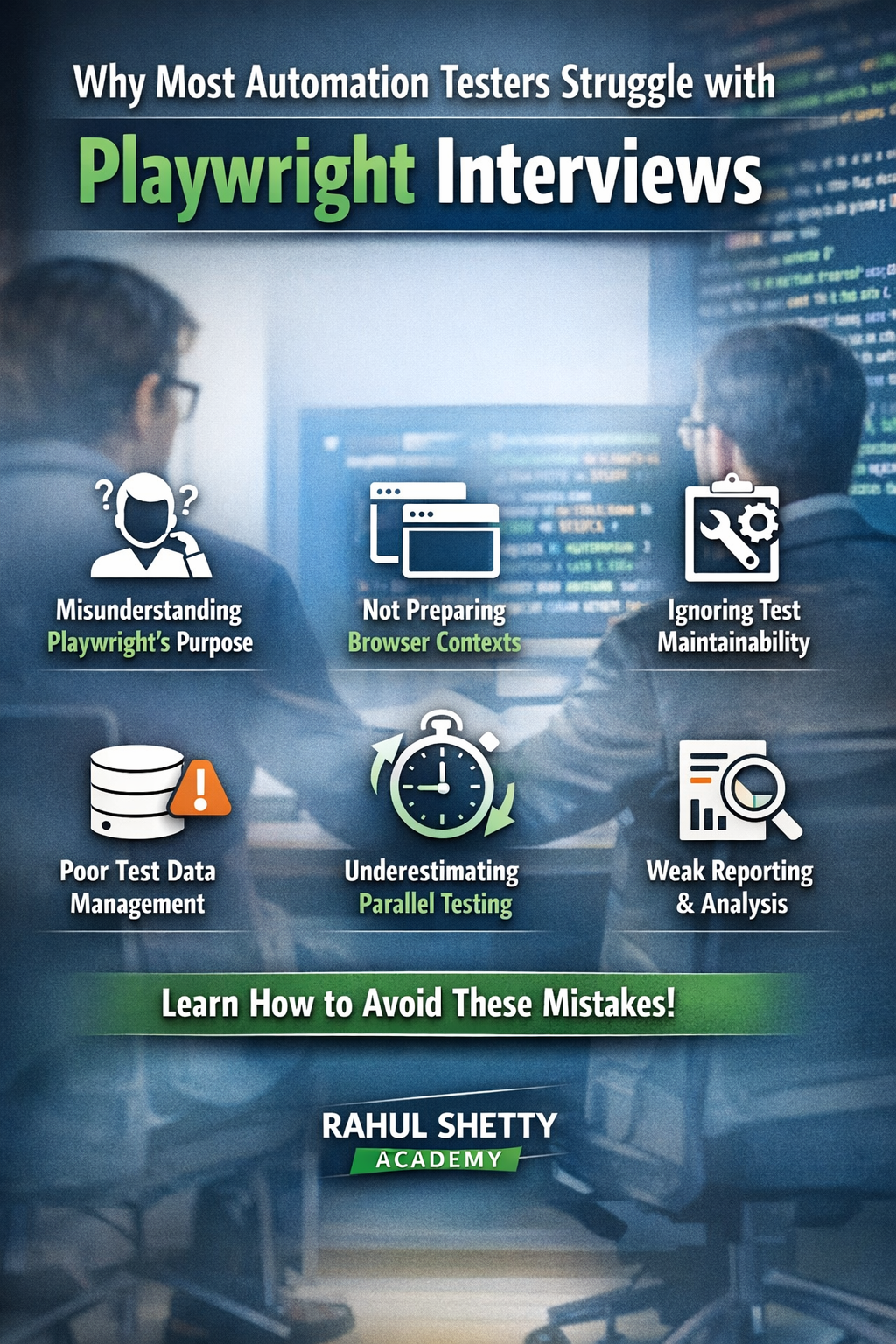
Let’s explore the most common reasons automation testers struggle with Playwright interviews and how you can avoid these mistakes.
The Hidden Reasons Automation Testers Fail Playwright Interviews
Misunderstanding the Purpose of Playwright
Many candidates approach Playwright interviews with the mindset that it is simply another automation tool similar to Selenium. This assumption often creates a gap during technical discussions.
Playwright aims to address many of the limitations that testers experienced with earlier automation frameworks. Modern web applications rely heavily on asynchronous rendering, dynamic components, and complex client-side interactions. Traditional automation tools sometimes struggle with these environments.
Playwright is designed with these modern challenges in mind. It provides features such as automatic waiting, browser context isolation, built-in network interception, and reliable cross-browser support. Interviewers often test whether you understand these architectural advantages. Instead of only describing Playwright as a tool for UI automation, you should explain why it performs better in certain scenarios.
For example, Playwright reduces synchronization problems because it automatically waits for elements to be ready before performing actions. It reduces flaky tests and improves automation stability. Candidates who understand the purpose behind the tool demonstrate deeper knowledge and stronger automation thinking.
Not Preparing Browser Contexts
Browser contexts are one of the most important architectural concepts in Playwright, yet many candidates struggle to explain them clearly. A browser context is essentially an isolated browser session within a single browser instance. Each context operates independently, meaning that cookies, storage, and session data do not get shared between contexts.
This capability is extremely useful for automation testing. For example, contexts allow engineers to simulate multiple users interacting with the same application at the same time. One context could represent a buyer while another represents a seller. Their sessions remain independent because each context gets isolated.
Browser contexts also improve test reliability. Since each test can run inside its own isolated environment, the risk of session conflicts or leftover data affecting other tests is reduced. Interviewers may ask you questions such as:
● Why are browser contexts important in Playwright?
● How do contexts improve test isolation?
● How can contexts help simulate multiple users?
Candidates who understand these concepts show a stronger grasp of Playwright architecture and automation best practices. Here, you may find a trusted source for all-access subscriptions to all the Playwright courses to learn the skills and get certifications.
Ignoring Test Maintainability
One of the biggest challenges in automation testing is long-term maintenance. It is easy to write a few test scripts that work initially. However, as the application grows and the test suite expands, maintaining poorly designed tests becomes extremely difficult.
Interviewers want to understand whether you think about maintainability when designing automation frameworks. A well-designed automation framework should prioritize:
● reusable components
● modular test structure
● centralized locator management
● easy debugging and updates
For example, using the Page Object Model helps separate page interactions from test logic. This approach makes it easier to update locators when UI changes occur. Automation frameworks that ignore maintainability often become fragile over time. Small UI changes may cause dozens of tests to fail. Companies prefer automation engineers who think about sustainability and long-term reliability when designing test frameworks.
Lack of Test Data Management Strategy
Test data management is another area where many automation testers struggle.
Automation tests often require specific datasets to execute correctly. These datasets may include user accounts, product records, transactions, or configuration information.
When test data is not managed properly, automation suites become unstable. Common problems include:
● tests failing because required data is missing
● conflicts when multiple tests use the same data
● inconsistent results across environments
Interviewers may ask you how you manage test data in your automation frameworks. Strong answers may include approaches such as:
● generating data dynamically through APIs
● storing test data in external files such as JSON or CSV
● using database queries to validate results
● cleaning up test data after execution
Automation engineers who design proper test data strategies build more reliable test suites. So, the learning paths you choose should guide you in an in-depth way, and you can go beyond surface-level answers.
Underestimating the Importance of Parallel Testing
Speed and efficiency are critical in modern development environments. Automation tests often run as part of continuous integration pipelines, where quick feedback is essential. Running large test suites sequentially can significantly slow down the development process.
Playwright supports parallel execution, allowing multiple tests to run simultaneously. It reduces overall execution time and improves productivity. However, parallel execution introduces its own challenges. Tests must be designed in a way that prevents conflicts between parallel runs.
For example:
● Test data should not overlap between tests
● Sessions should remain isolated
● Shared resources must be managed carefully
Interviewers often evaluate whether you understand how parallel execution works and how to design tests that remain stable in parallel environments. Automation engineers who understand parallel testing are better prepared to work in large-scale projects.
Not Comprehending Reporting and Test Visibility
Automation testing is not only about executing tests. It is also about providing meaningful insights to development teams. Clear reporting helps teams understand:
● Which tests pass
● Which tests fail
● Where failures occur
● How frequently issues appear
Playwright supports various types of reporting formats that help teams analyze automation results effectively. Automation engineers should understand the importance of creating clear and structured test reports. These reports help developers and product teams to identify problems and take corrective action ASAP.
Interviewers may ask you questions such as:
● How do you analyze automation results?
● What type of reporting mechanisms do you use?
● How do teams track automation progress?
Candidates who emphasize transparency and reporting demonstrate a broader understanding of automation value.
Weak Understanding of Test Reliability
One of the biggest goals of automation testing is reliability. A test suite that frequently fails due to unstable automation is often considered unreliable and may lose the trust of development teams. Interviewers often evaluate whether candidates understand how to design reliable tests.
Some common strategies for improving reliability include:
● Using stable locator strategies
● Avoiding unnecessary hard waits
● Implementing proper synchronization
● Isolating tests from each other
Playwright provides built-in features such as automatic waiting, which helps reduce many common synchronization problems. Automation engineers who focus on reliability help ensure that test results accurately reflect the behavior of the application. Reliable automation builds confidence within development teams.
Limited Awareness of Real World Automation Challenges
Many candidates prepare for interviews using simple sample projects or small practice exercises. However, real-world enterprise applications often introduce much greater complexity. Automation engineers may encounter challenges such as:
● Slow or unstable environments
● Constantly changing user interfaces
● Complex authentication flows
● Integrations with external services
● Multiple user roles interacting simultaneously
Interviewers often use scenario-based questions to evaluate how you would handle these challenges. Candidates who have practiced real-world testing scenarios tend to provide more confident and detailed answers. Hands-on practice with realistic applications helps build both technical skills and problem-solving abilities.
Neglecting Version Control and Collaboration Practices
Automation testing rarely happens in isolation. Automation engineers usually work as part of larger development teams. Test scripts and frameworks are often stored in version control systems such as Git.
Understanding version control practices is an important part of modern automation workflows. You should be familiar with concepts such as:
● Repositories and branches
● Pull requests and code reviews
● Merging automation updates with application code
These practices help teams collaborate effectively and maintain the quality of automation frameworks. Interviewers may ask you about your experience working with version control systems. Demonstrating awareness of collaborative development processes shows stronger industry readiness.
Not Preparing for Scenario-Based Questions
Many Playwright interviews now focus on scenario-based discussions rather than simple knowledge questions. Instead of asking definitions, interviewers may present practical situations and ask you how you would approach them.
Examples of scenario-based questions include:
● How would you automate a workflow involving multiple user roles?
● How would you handle flaky tests in a CI pipeline?
● How would you test a feature that depends on several backend APIs?
These questions evaluate problem-solving ability and automation strategy. Candidates who practice thinking through real automation scenarios often perform better in interviews. Developing this type of thinking requires both hands-on experience and structured preparation. Here, you will need proper mentorship to get prepared in the right way so you can shine through all the questions.
If you want to perform better in Playwright interviews, the key is not just learning commands but building a real understanding through structured practice. Focus on designing frameworks, handling real testing scenarios, and gaining confidence in explaining automation strategies during technical discussions.
For those looking to develop deeper expertise, structured learning platforms can make the journey much smoother. Rahul Shetty Academy offers practical training specifically for automation engineers who want to move beyond theory. Through his comprehensive course, certification plans, and expert guidance, aspiring testers like you can gain hands-on experience with modern automation tools and industry-relevant testing practices. So, wait no more and strengthen your Playwright skills.